Report By CBN247 :
In the high mountains of Tirah Maidan, silence once carried peace. Today, it carries uncertainty.
Families are leaving again.
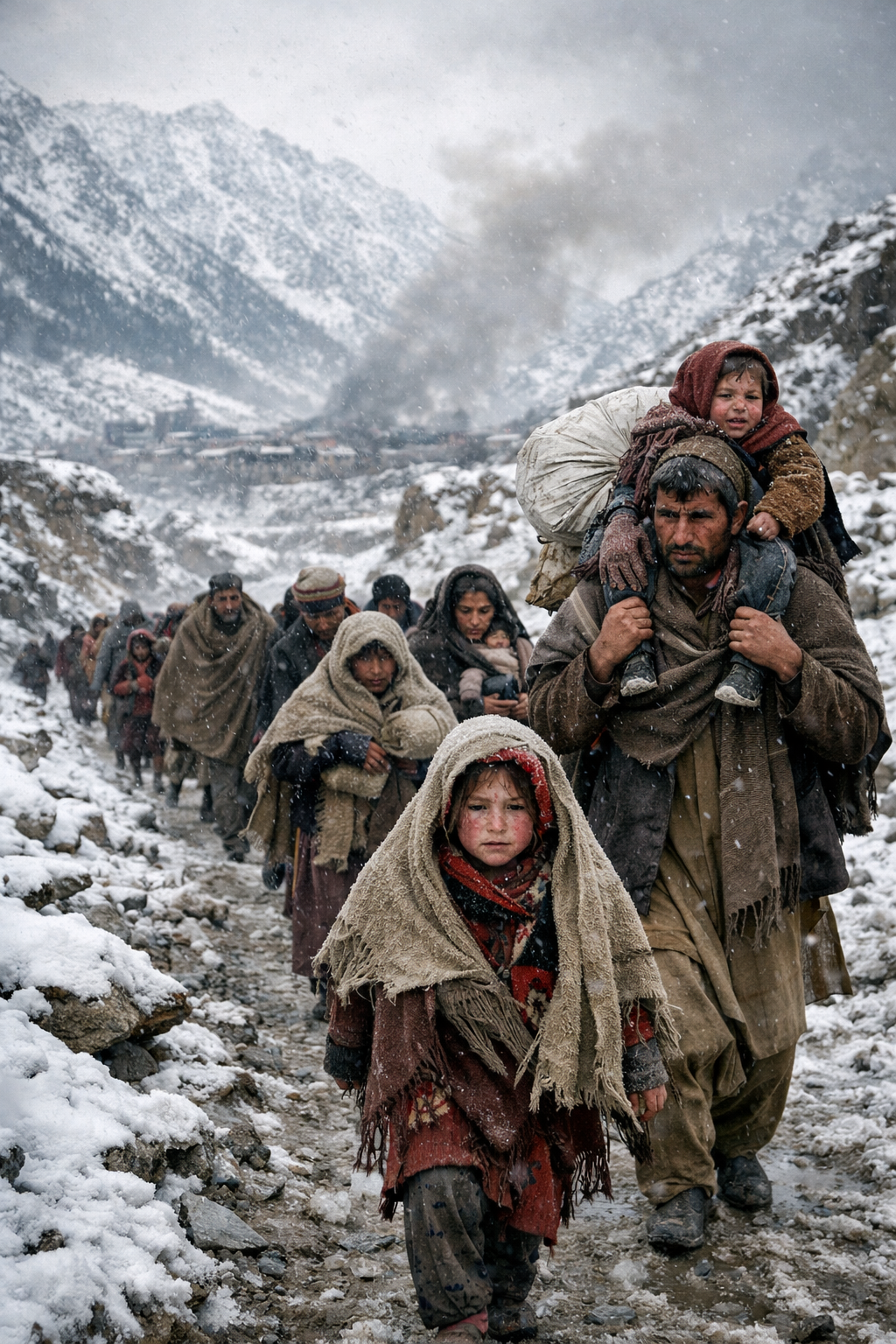
As security operations intensify in parts of this remote region of Khyber Pakhtunkhwa, thousands of residents are moving out of their villages, not by choice but by necessity. For many, this is not the first displacement. Some families are facing it for the third time.
District officials say nearly 5,000 registration tokens have been issued so far. On the roads, however, numbers fade into human reality: stalled vehicles, freezing nights, anxious children, and families unsure of where they will sleep next.
Fleeing Under Pressure
Mufti Kafil, Chairman of the Bara Tehsil Council, recently visited Central Bagh and Pindi Cheena, where displaced families are gathering. He described a tense and hurried evacuation.
“People were leaving under pressure,” he said. “There were repeated announcements to evacuate, and in some areas, families were moving while firing could still be heard.”
At Pindi Cheena, more than a thousand vehicles lined the roadside. Many families spent the night inside their cars or under open skies. Elderly people and young children bore the worst of the cold.
Local elders told officials that basic facilities promised at transit points were either missing or delayed. Drinking water, toilets, heating arrangements, and clear instructions were still inadequate.
A Crisis of Information
Journalist Islam Gul Afridi, reporting from Tirah villay and nearby transit routes, highlighted what he called one of the most damaging yet invisible problems: lack of communication.
“Large parts of Tirah have no mobile signal or internet,” he said. “Families are moving without reliable information. Many do not know where to register or which route is safer. By the time they receive updates, it is often too late.”
According to him, this communication gap has created confusion and overcrowding at registration points. Families arrive exhausted, only to learn that procedures have changed or systems are down.
For women traveling alone with children and for elderly people, this uncertainty adds another layer of fear.
Long Waits in the Cold
Muhammad Farooq Afridi, reporting from Pindi Cheena and surrounding areas, focused on the conditions at registration centers.
“People are waiting for hours in freezing weather,” he said. “Some families reached registration points late at night and stayed there until morning because the system was not working.”
He reported technical faults in registration systems that left families stranded without confirmation. “Many are worried that if they are not registered properly, they will miss assistance later,” he added.
Islam Gul Afridi noted that repeated displacement has also taken a psychological toll. “People are not just tired physically. They are emotionally exhausted. Each displacement reopens old wounds.”
When Winter Becomes an Enemy
While conflict has forced families to leave, winter has made the journey harsher. Routes such as Dwatoi Tan and Maidara have become dangerous due to snowfall, freezing rain, and muddy terrain.
Vehicles break down. Traffic stalls for hours. Some families are forced to walk long distances in cold conditions.
Khalil Khan Afridi described the journey as increasingly risky. “This winter is different,” he said. “The weather is more unpredictable. People are escaping violence, but the cold itself is becoming another threat.”
For residents of Tirah, climate change is not an abstract issue. It is felt in harsher winters, blocked roads, and longer exposure to the elements during displacement.
Community Support, Limited Relief
In the absence of a fully organized response, local volunteers and civil society groups have set up small relief points. Tea, bread, and blankets are being distributed where possible.
“These efforts are helping people survive the night,” said Khalil Khan Afridi, “but they are not enough for a crisis of this scale.”
Mufti Kafil has appealed to the provincial government and to well-off members of society, reminding them that those on the roads are not strangers. “These are our own people,” he said. He urged authorities to improve registration through tribal structures and to deploy heavy machinery to keep routes open.
Waiting Between Past and Future
As night falls across the Khyber hills, thousands remain on the move. Behind them are homes they were forced to leave. Ahead lies uncertainty, overcrowded shelters, and the challenge of rebuilding once again.
Parents try to reassure their children. Elders sit quietly, watching the road.
For the people of Tirah, displacement is not only about movement. It is about endurance, dignity, and the hope that one day they will no longer have to leave to stay alive.
This winter feels colder not just because of the weather, but because it keeps returning.
Protest in Bara Reflects Civilian Anguish
In Bara, residents, civil society members, and tribal elders gathered to protest the ongoing military operation in Tirah Valley and the forced displacement of local families. Demonstrators voiced concern over civilians being asked to leave their homes during harsh winter conditions, calling it a violation of basic human dignity.
Speakers described the protest as a collective appeal from affected communities rather than a political act. Displacement without delivering lasting peace, pointing to the long-term toll on families, including loss of homes, livelihoods, and social stability.
Participants urged authorities to halt forced displacement, ensure the safe and dignified return of affected families, and prioritize dialogue and justice over continued cycles of evacuation. The protest remained peaceful, though organizers warned that public pressure would continue if civilian concerns are not addressed.