

By Muhammad Younas
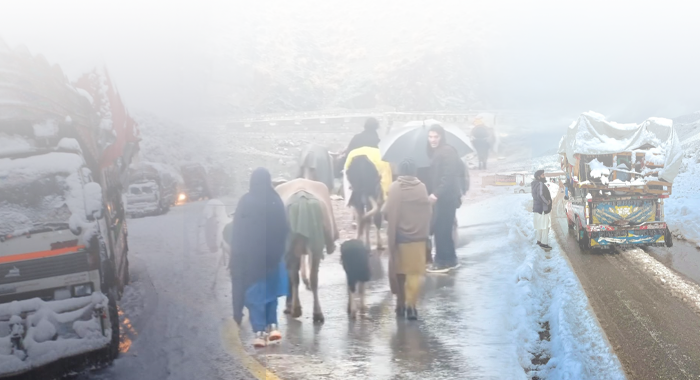
TIRAH VALLEY / BARA — On the dusty roads leading out of Pakistan’s Tirah Valley, the argument over who is responsible for displacement feels distant to the families sleeping inside vehicles, huddled against the cold, and waiting for their names to be called.
For them, survival has little to do with narratives.
Displacement from Tirah has entered its tenth consecutive day, marking yet another chapter in a region where families have repeatedly been forced to leave, return, and leave again. According to district administration officials, more than 6,500 families have completed biometric verification through NADRA, while over 27,000 families have been issued initial tokens that allow them to receive transportation assistance. Authorities say conditions remain difficult, but signs of gradual improvement are beginning to emerge.
On the ground, however, hardship continues.
Thousands of families remain on roadsides, spending days and nights outdoors as they wait for registration. Women hold infants close to their chests. Elderly men sit silently, leaning on walking sticks. Children wander between vehicles, asking for water.
“We have been here for days,” said a displaced father waiting near Painda Cheena. “We hear many statements on television, but here, life feels frozen.”
Registration Amid Strain
District officials say the registration process is being carried out under intense pressure. Registration points remain open late into the night to accommodate as many families as possible. Women and children are prioritised during initial screening, followed by male family members.
Temporary shelter and basic facilities are being provided at Paindi Cheena Camp, where displaced families arriving from Tirah are offered food, water, and medical support. Yet capacity remains strained, and the pace of arrivals has tested both systems and patience.
The administration has also acknowledged challenges of exploitation during the process.
On Wednesday, displaced families reported that certain individuals were demanding illegal payments of 1,000 to 2,000 rupees in exchange for tokens or assistance with identity records. Acting on these complaints, Additional Assistant Commissioner Amanullah, accompanied by the SHO of Bazaar Zakhakhel, conducted an operation near Painda Cheena School. Eight individuals were arrested for allegedly extorting money, illegally handling identity cards, and manipulating addresses. Authorities say fake tokens, identity cards, and cash were recovered, and legal proceedings are under way.
Officials insist that monitoring teams are overseeing every stage of registration to prevent further abuse.
The Battle of Narratives
Even as families struggle on the roads, a different battle is playing out on television screens and social media platforms. Competing narratives, political blame, and selective storytelling dominate mainstream and digital media.
“Everyone is busy proving who is right and who is wrong,” said Islam Gul, a senior journalist based in Khyber District. “But in the middle of these debates, the human being disappears. The suffering is reduced to statistics or political talking points.”
Islam Gul notes that misinformation and emotional framing have further confused the public. “Some narratives exaggerate, others deny. Both harm the displaced because they delay serious attention to real needs.”
Haq Nawaz Khan, a media analyst and civil society voice, believes the blame game has deepened mistrust. “Social media amplifies anger, while mainstream media often simplifies a complex crisis,” he said. “The result is noise instead of clarity. Families need protection and assistance, not competing headlines.”
Both journalists stress that ethical reporting during displacement requires restraint, verification, and empathy. “Words matter,” Afridi added. “They shape response, policy, and public compassion.”
Lives Reduced to Waiting
For displaced families, the clash of narratives offers little comfort.
Many of those now fleeing Tirah are not first-time displaced. They returned years ago after militancy subsided, rebuilt damaged homes, planted crops, and tried to restore normal life. That fragile recovery has once again been interrupted.
“I rebuilt my house with my own hands,” said a resident from Shobar village. “Now it stands unfinished. I locked the door without knowing when I will see it again.”
Such stories are common across Tirah, where poverty, geography, and insecurity intersect. Winters are harsh, livelihoods limited, and access to markets costly. Each displacement strips families not only of shelter, but of confidence that rebuilding will last.
Humanitarian workers warn that repeated displacement has long-term psychological effects, especially on children. Interrupted schooling, exposure to uncertainty, and the loss of routine leave deep scars that are rarely addressed once emergencies fade from headlines.
Administration Under Pressure
District officials argue that they are responding within available capacity.
According to administration sources, biometric verification and SIM issuance are progressing daily, while transportation assistance is being disbursed through token-based systems. Authorities say the goal is to ensure transparency and prevent duplication, though they acknowledge delays and frustration.
“The scale of displacement is large,” an official said, speaking on condition of anonymity. “We are trying to improve coordination, but terrain, weather, and volume are serious challenges.”
Civil society groups have urged stronger coordination between departments, clearer public communication, and independent oversight to ensure that assistance reaches the most vulnerable without discrimination or delay.
Beyond Blame
As night falls over Painda Cheena, fires are lit along the roadside. Families gather around them, sharing tea, bread, and silence. Children fall asleep on sacks of belongings. Elderly women whisper prayers.
For them, the crisis is not a debate.
“When narratives clash, families pay the price,” Islam Gul said. “And that price is paid quietly, away from studios and screens.”
Haq echoed the concern. “If we truly care about stability and peace, we must centre people, not positions.”
As displacement from Tirah continues, the measure of success will not lie in statements issued or arguments won, but in whether families are protected with dignity, assisted without exploitation, and given a genuine chance to rebuild lives that have already been interrupted too many times.
In Tirah, uncertainty remains the only constant.