
Women carry the hidden cost of decades long uncertainty conflict and displacement in
Pakistan’s Tirah Valley
By Muhammad Younas :
TIRAH VALLEY, Pakistan — The wind in the high mountains of Tirah Valley carries more
than cold. It carries the memory of departure, sweeping through empty courtyards and
frozen paths where families once lived. Here, in the borderlands of Pakistan, the idea of
home has become something fragile, packed and unpacked so many times it no longer
holds its shape.
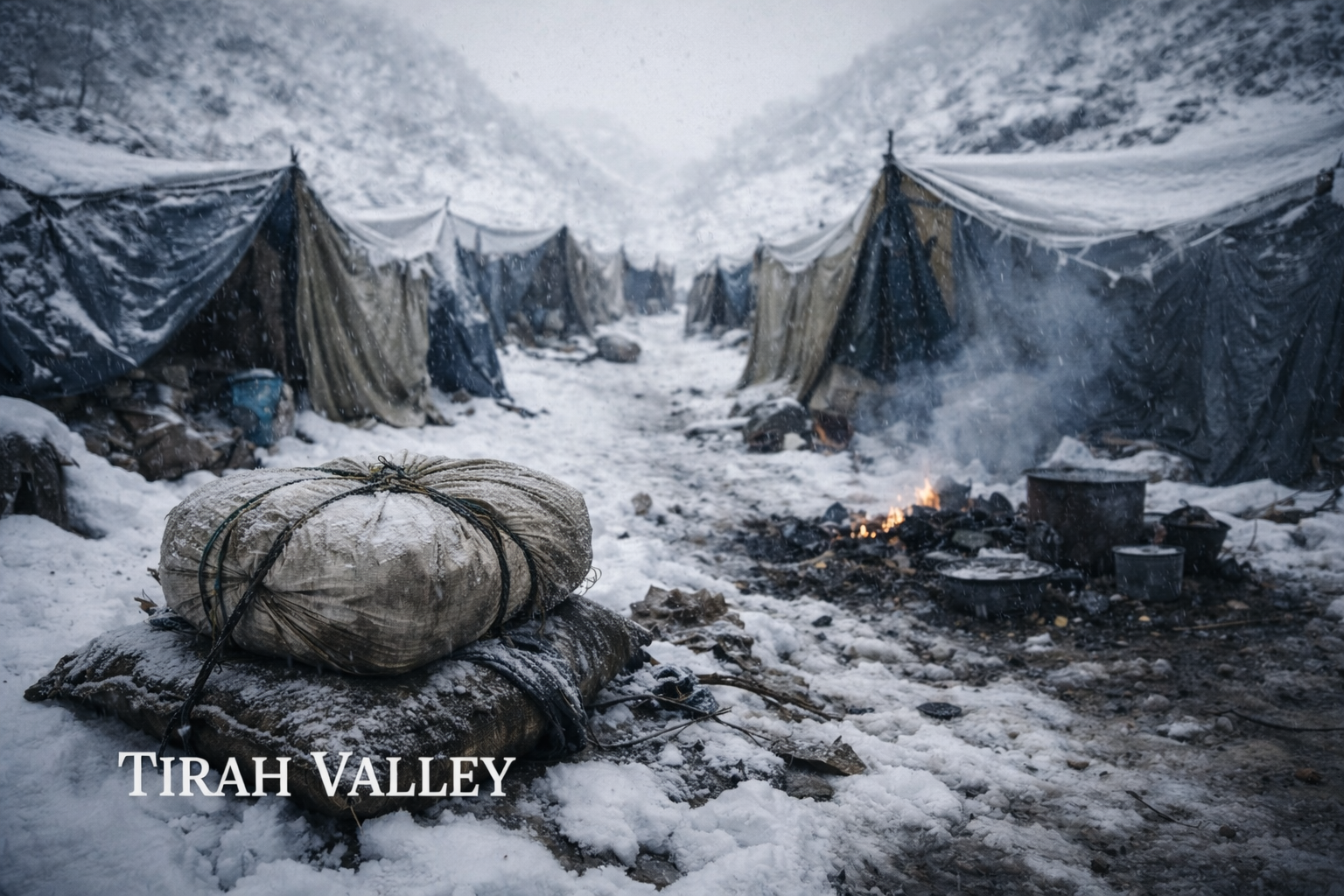
This winter arrived with heavy snow. In different parts, Passes, Villages like Takhtakai,
Darbar,Malakdin Khel, peer Mila, dawatoi, Mir dara and Bar Qamber Khel disappeared
under white silence. In the upper reaches of Bar Bagh and Momand Ghuz, snow piled three
feet deep, sealing doors and stopping daily life. The Maidan Bagh Bazaar closed. Roads
vanished. For the women of Tirah, the stillness brought no peace. It brought weight.
“The men worry about transport, taking care of belongings, relief tokens, registration forms,
verification and SIM cards,” she said. Her voice was quiet, worn by mountain air and
repetition. “We worry about everything else.”
A familiar displacement
The registration process for families displaced from Tirah Valley has now entered its sixth
week. According to official records, 19,586 families have been registered so far, exceeding
the number initially identified by the authorities. At the same time,hundreds of families
remain stranded inside the valley, unable to reach registration centers due to heavy snowfall
and blocked roads.
Sources within NADRA confirmed that registrations were carried out at multiple designated
points. However, the overall figures now surpass the estimated caseload identified earlier
through polio and population data. This discrepancy has raised concerns about the possible
inclusion of non-eligible individuals, while a significant number of genuinely affected families
remain unregistered.
The situation highlights growing questions around the transparency and accuracy of the
registration process, particularly when access constraints continue to prevent some of the
most vulnerable families from being counted. As displacement continues, ensuring that
assistance reaches those most in need remains a critical humanitarian and ethical priority.
For aid organizations, this qualifies as a humanitarian emergency. For the women
experiencing it, this is routine. Many are fleeing for the second or third time. They have
carried their lives on their backs before.
The journey from Tirah once took hours. Now it stretches across days. Families sleep in
truck cabins with engines turned off to conserve fuel. They huddle together under shared
blankets, using body heat to fight the winter cold.
At a roadside stop, a mother sat among her remaining possessions. A few goats. Some
hens. Bundles of grain tied with careful knots. She held her youngest child while her two
older children slept on sacks of grain, the literal seeds of a home they no longer occupied.
“This time felt different,” she said, rocking the infant gently. “My heart started racing before I
even touched the door handle. My body remembered the road before my mind knew we
were leaving.”
Trauma beyond numbers
In the tribal Pashtun communities of Tirah, displacement is not recorded only in data and
figures. It is felt in the body. Long before women speak about fear or loss, their sleep breaks
into short, restless stretches. The cold settles deeper in their bones. Every sound feels like a
warning.
When families leave their homes, women lose more than shelter. They lose privacy, routine,
and dignity built around the rhythms of daily life. In crowded roadside stops and temporary
facilitation points, no proper and right information basic needs are pushed aside. Pregnancy
continues on the move. Menstruation becomes a quiet struggle in places where privacy is
scarce and modesty is deeply valued.
Najma Gulab, a clinical psychologist who works with displaced communities in the region,
describes what she sees as a silent crisis.
“When displacement happens in winter, women’s physical needs collide with emotional
stress,” she said. “Breastfeeding mothers worry constantly about whether their children will
survive the cold. That fear stays in the body.”
In Pashtun society, where purdah shapes how women move and live, the absence of
separate spaces turns ordinary acts into sources of distress. Many women respond by
withdrawing, speaking less, asking for little. Few name their experience as trauma. They
simply know they are exhausted in ways that rest cannot repair.
The uncertainty that breaks
Asghar Jan has worked as a journalist in this region for years, documenting the cycles of
displacement that have marked Tirah. He has watched families leave and return, repair and
flee again. According to Jan, fear is not what ultimately breaks people here.
“The population is accustomed to movement,” Jan said. “What destroys them is the
uncertainty. Not knowing when they can return. Not knowing if the house they just rebuilt will
still be standing when the next wave of insecurity arrives.”
For women, this uncertainty cuts particularly deep. Homes that were repaired after previous
displacements were never fully restored. Livelihoods that resumed never achieved real
stability. Each return carried an unspoken question. How long before we must leave again?
While government authorities continue to share updates on registration and relief
distribution, many women remain burdened by worry. Their concern is not only for
themselves, but for the men left behind, struggling to care for elderly family members,
protect what remains of their homes and belongings, and keep their children safe.
Those still trapped
In areas where snow has blocked all passage, families remain stranded. Food supplies grow
thinner by the day. Roads stay impassable. Civil organizations continue relief efforts,
working to clear routes and deliver rations, but progress is slow. In these isolated
households, women are quietly eating less, stretching meager supplies to feed their children
first.
Sajid Zaheer, a resident of the valley, described a journey that would normally take three
hours but stretched into three days as snow and blocked roads slowed their progress. Along
the way, his family spent two nights exposed to the cold, one near Dawatai and the other in
Toot Dara.
The conditions were harsh, and the strain was visible. Yet Sajid said his elder son, Hussain
Ahmad, remained alert and talkative throughout the journey, a small sign of resilience amid
uncertainty. The youngest child, Mohsin, became ill due to the cold and was later examined
by a doctor. The family hopes he will recover soon.
For Sajid, the journey home was more than a passage through mountains. It was a measure
of endurance, shaped by weather, distance, and the quiet resolve of a family carrying
through displacement under winter’s weight.
Among the women, resilience is rarely loud or visible. It often takes the form of quiet
persistence, worn thinner with each displacement. Near a facilitation center in Upper Bara,
an elderly woman sat inside her vehicle, watching silently as people moved around her. Her
voice, when she spoke, was soft but steady.
“We are tired of starting again,” she said. “But we do it anyway, because our children must
live.”
A relief worker at the site noted that women and children continue to bear the heaviest
burden of uncertainty, paying the highest price in a crisis marked by repeated displacement
and harsh winter conditions.
Beyond emergency response
What is unfolding in Tirah Valley is not a sudden disaster. It is a prolonged condition of
displacement that repeats in cycles. Registration processes continue. Road-clearing
operations proceed. But critical services remain scarce. Mental health care, reproductive
health support, and protection programs centered on women’s needs are limited or absent.
Until the humanitarian response shifts beyond treating each displacement as a temporary
emergency and begins addressing it as a long-term reality, women will continue rebuilding
lives that are never permitted to settle. They are expected to demonstrate strength, to adapt
without complaint, to endure without breaking.
As winter deepens across the valley, families continue to move forward, not out of strength,
but out of necessity. Children huddle under thin blankets, women carry the weight of
repeated displacement, and homes stand empty behind them. Their quiet endurance should
not be mistaken for acceptance or resilience alone; it is a daily negotiation with uncertainty,
hardship, fear, displacement and survival. Behind every snow covered path and temporary
shelter are people striving to survive, their courage measured not in words, but in the simple
acts of carrying on.