

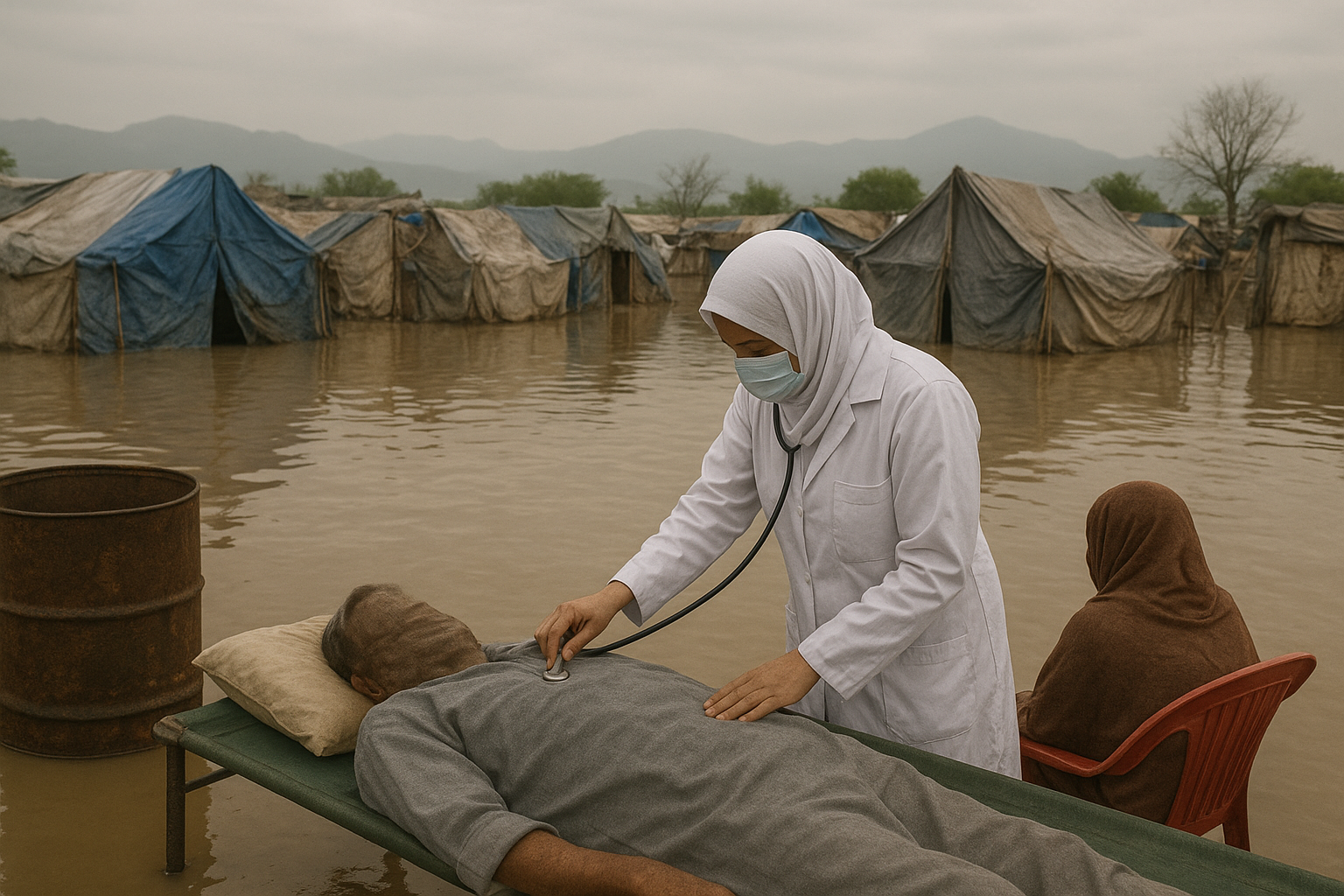
Peshawar, August 28 – The Khyber Pakhtunkhwa (KP) Health Department has released fresh data on the monitoring of communicable diseases in flood-affected districts, highlighting a growing health crisis in the wake of recent flooding.
According to the department’s spokesperson, 5,752 patients were examined on August 28 alone, with mobile health teams extending services to 2,445 people. A total of 136 static health camps and 36 mobile units remained operational across the province to provide emergency medical care.
Since the onset of floods, authorities have examined over 516,257 patients in affected districts. The health system itself has suffered significant damage, with three Basic Health Units (BHUs) completely destroyed and 57 partially damaged, while 28 Lady Health Workers lost their homes entirely and 32 others reported partial damage.
On August 28, health officials confirmed no deaths but reported four flood-related injuries.
Disease Burden Rising
The department noted that floodwaters and poor sanitation are driving a surge in communicable diseases. Respiratory illnesses remain the most common, with 1,143 cases reported from Dera Ismail Khan (DI Khan) on August 28. Similarly, non-bloody diarrhea recorded 1,143 cases in DI Khan and 1,116 in Nowshera, while bloody diarrhea cases reached 42 in DI Khan and 36 in Nowshera.
Other waterborne and vector-borne diseases are also spreading rapidly:
• Scabies (skin infections): 1,143 cases in DI Khan; 1,116 in Nowshera
• Eye infections: 1,143 in DI Khan; 1,116 in Nowshera
• Malaria: 1,143 in DI Khan; 1,116 in Nowshera
• Snake bites: 1 case each in DI Khan and Nowshera
• Dog bites: 1 case each in DI Khan and Nowshera
• Dengue fever: 5 cases in DI Khan; 4 in Nowshera
Strict Monitoring in Place
The KP Health Department emphasized that continuous surveillance is being carried out to track and contain the outbreak of infectious diseases in all flood-affected areas. Mobile and static health teams are conducting door-to-door visits and operating temporary camps to provide essential medicines and treatment.
Officials reiterated that the health emergency is far from over, as stagnant floodwaters, damaged infrastructure, and overcrowded shelters continue to pose serious risks of epidemics.