By Muhammad Younas and Islam Gul
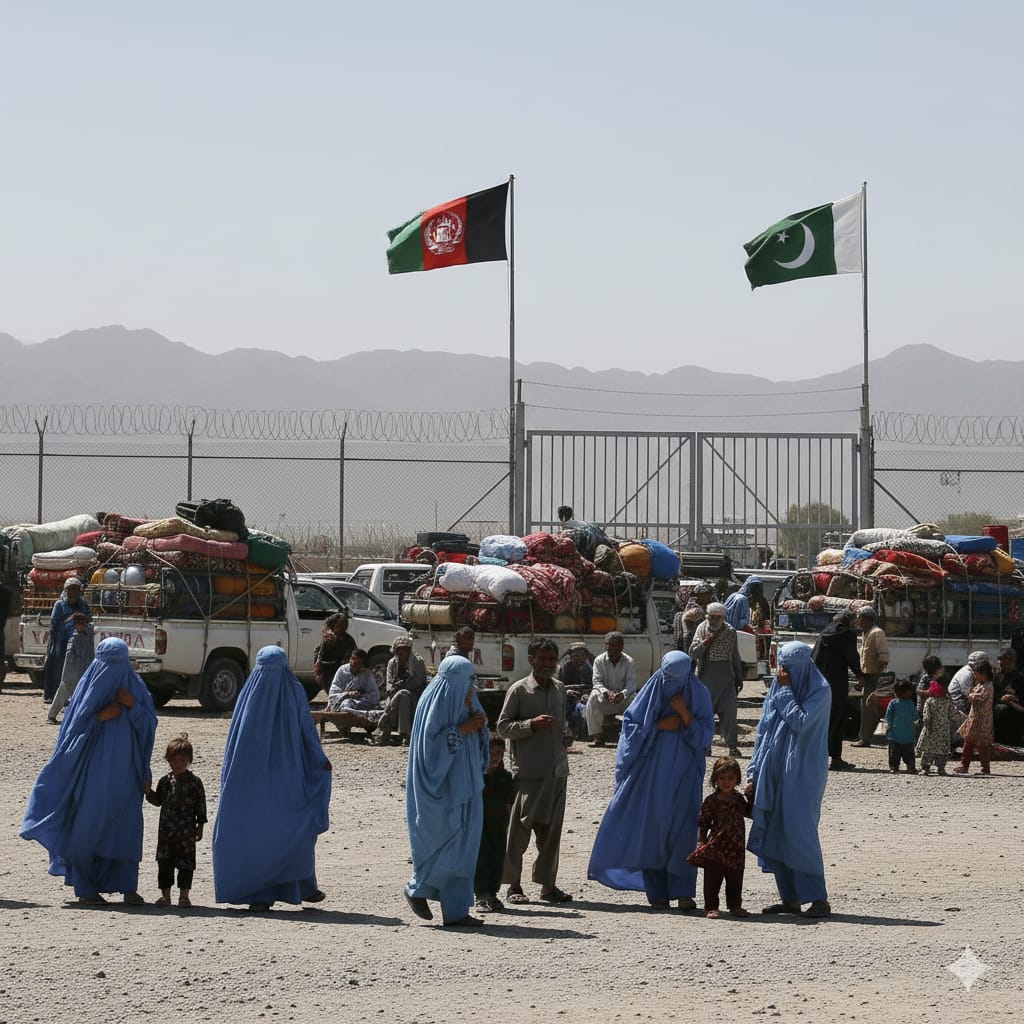
The dusty hills of Khyber have turned silent. Where trucks once rumbled through the Torkham crossing day and night, hundreds of vehicles now stand still in the fading autumn sun. Families sit beside their packed belongings, waiting for a border that refuses to open. What began as a security incident on the Pakistan–Afghanistan frontier has now become a humanitarian crisis, trapping thousands of people between two nations and two uncertain futures.
The closure came after an exchange of fire on the night between October 11 and 12, when Pakistan said its security posts were targeted from across the Afghan side. In response, Islamabad sealed all major crossings, including the Torkham Gate. The decision brought movement and trade between the two countries to an abrupt halt. Officials say that before the shutdown, nearly ten thousand people and more than five hundred trucks passed through this route daily, carrying goods, patients, students, and divided families. Now the long queues of trucks and stranded travelers have replaced the sound of commerce with the quiet murmur of waiting.
From a Border Dispute to a Global Concern
The situation at Torkham is not only a local matter. It is part of a larger global story about migration, security, and the world’s growing discomfort with displacement. According to the UN Refugee Agency, more than 122 million people are currently displaced worldwide, a figure that reflects the highest level of human movement in modern history. Each border closure—whether in Europe, America, or South Asia—adds another layer to this global struggle between national security and human survival.
For Pakistan, the challenge is particularly complex. The country has hosted millions of Afghan refugees for more than four decades. At one time, their numbers crossed 3.7 million. Today, about 1.2 million are registered with the government, while hundreds of thousands more live without documentation. The recent decision to accelerate the return of refugees has been described by officials as a necessary step, but for many Afghans, it means uncertainty and fear.
Lives on Hold
At the Jamrud facilitation center, families wait inside trucks and temporary shelters. Children run between parked vehicles, their laughter mixed with coughs from the dust. Mothers cradle their infants, fanning them with pieces of cardboard. Men sit quietly, counting the money that is almost gone.
Among them is Abdul Haq, who started his journey from Chitral nearly two weeks ago. He traveled with seven trucks carrying families and their belongings. “We have been here for eleven days,” he says, his voice tired but calm. “Women and children are getting sick. We have food for only a few more days. We don’t know when we will be allowed to cross.”
Nearby, Mohammad Agha, a 30-year-old driver, leans against his truck. He explains that the families he is carrying had paid him 315,000 rupees to reach Kabul. “Now everything is uncertain. Every extra day costs more. The children cry at night. We just want to move.”
An elderly man, Khan Mohammad, sits on a mat beside his truck. He left Chitral with hopes of returning home to Kabul but has spent eleven days waiting at the border. “We only ask the two governments to open the border on humanitarian grounds,” he says. “We want to go home with dignity.”
Officials at the Jamrud center say they are providing all available facilities, including water and basic medical support. Yet many refugees insist that the conditions are inadequate and ask for permission to move closer to the crossing. Authorities have refused, citing safety concerns and the absence of secure shelter beyond the checkpoint.
Trade Frozen, Livelihoods Lost
The closure has also struck at the heart of trade between Pakistan and Afghanistan. Truck owners, traders, and laborers have been hit the hardest. Rehmanullah, a truck driver from Landi Kotal, explains that each idle day means financial loss. “We spend on food and parking, but no one pays us back. It all comes from our own pockets,” he says.
Before the closure, trade was already slowing due to political tensions, rising tariffs, and a falling currency. Now, the complete halt has left traders deeply worried. A senior official from the **Pakistan–Afghanistan Joint Chamber of Commerce said the prolonged disruption could push many small businesses to collapse and encourage smuggling through unsafe routes. “Torkham is not just a crossing point,” he said. “It is the economic heartbeat of two fragile economies.”
Diplomacy in Motion
Diplomatic efforts are under way to reopen the crossing. Pakistan’s Defense Minister Khawaja Asif, with Qatar acting as mediator, has led a first round of talks with the Afghan Taliban. The discussions, held recently, were described as “positive,” and a second round is expected soon in Istanbul. The talks aim to reduce tension and restore the flow of people and goods across the border.
In Khyber Pakhtunkhwa, newly elected Chief Minister Sohail Afridi has called for closer coordination between Islamabad and the provincial government. In his first address, he emphasized that decisions affecting Afghan refugees should include voices from the border regions that host them. He also said that more than 800,000 Afghan refugees have already returned this year, while around 1.2 million remain in Pakistan.
The Global Reflection
The waiting at Torkham mirrors scenes unfolding across the world. From the U.S.–Mexico border to the Mediterranean, the struggle between national policy and human need continues. According to the UNHCR’s 2024 Global Report, 1.6 million refugees and more than eight million internally displaced people tried to return home last year, many to fragile and unsafe regions. The problem is not just about returning—it is about rebuilding lives in a place that is often no longer home.
Pakistan’s long record of hosting Afghan refugees remains one of the most significant humanitarian efforts in modern history. Yet, as global attention shifts elsewhere, the burden has become heavier. “The world must look at Pakistan’s situation with understanding,” says Farzana Ali, a journalist from Peshawar who has reported on refugee issues for over a decade. “You cannot simply tell people to go home without making sure that home is safe.”
A Plea Beyond Borders
As evening falls, the hills around Torkham glow in the soft light of sunset. Children chase each other between parked trucks, their laughter echoing against the quiet mountains. Across the border, Afghan officials say they are ready to receive returnees, but their facilities remain limited. For thousands like Abdul Haq and Khan Mohammad, the dream of returning home has become a test of endurance.
The Torkham border, once a passage of hope, now stands as a reminder of the world’s unresolved promise to the displaced. Every stranded family carries a story that crosses more than one frontier — a story that asks a simple question of humanity: when politics close the gates, who will open the road home?