By Shamsul Haq
At a time when the country is witnessing growing anticipation over two major political movements — the Jamaat-e-Islami’s long march towards Islamabad on September 20, announced by its Emir Hafiz Naeemur Rehman against the petroleum levy, and the Pakistan Tehreek-e-Insaf’s already announced September 27 long march demanding an end to its founder Imran Khan’s solitary confinement, provision of medical facilities and his release from prison — debate over the creation of new provinces and administrative units is also gaining momentum. At the same time, in the context of the Iran-US war, global peace, particularly peace in the Middle East, is facing serious threats.
Although the sit-ins staged by Jamaat-e-Islami in different cities across the country for almost a month have not attracted large numbers of ordinary citizens beyond its own members and workers, one thing is significant: even if people are not turning up at the sit-ins in large numbers, Jamaat-e-Islami and its protests are being widely discussed on television, social media platforms, and in local gatherings, hujras and baithaks. The party’s social media campaign is also highly active. As a result, both the government and the general public are taking Hafiz Naeemur Rehman’s September 20 call seriously. The sit-in led by the late Qazi Hussain Ahmad against the government of Benazir Bhutto has not yet faded from public memory.
In the prevailing international situation, particularly amid the recent escalation in the Gulf region, the federal government may not be able to meet all of Jamaat-e-Islami’s demands, but it will certainly have to do something to avert or defuse the proposed sit-in. Otherwise, the government could find itself facing an even more difficult situation.
Similarly, the Pakistan Tehreek-e-Insaf leadership also appears to be in the mood for what it may regard as a final call. The successful street movements in Khyber Pakhtunkhwa and subsequently in Sindh have boosted the confidence of Chief Minister Sohail Afridi. The aggressive statements by the party’s Secretary General Salman Akram Raja, coupled with the encouragement being offered by Maulana Fazlur Rehman, could further intensify the situation.
Meanwhile, preparations also appear to be under way by the government to put pressure on the PTI. Old case files are being reopened, and arrest warrants are being issued. Non-bailable arrest warrants have reportedly been issued against Chief Minister Sohail Khan Afridi, Information Minister Shafi Jan, Mardan’s MNA Atif Khan and other leaders. There are also reports of a crackdown on party workers in Punjab.
In the Islamabad High Court, Chief Justice Dogar has taken up a petition filed by a citizen against the PTI’s proposed long march and has summoned the chief secretaries, inspectors general of police and advocate generals of all four provinces in person. The court has been hearing the matter almost on a daily basis. During the hearing of the petition the other day, Khyber Pakhtunkhwa Advocate General Shah Faisal questioned the jurisdiction of the Islamabad High Court in the matter. He argued his government’s position forcefully and engaged in a detailed exchange with Justice Dogar. It remains to be seen what decision the Islamabad High Court reaches. However, Rana Sanaullah Khan appears to have already delivered his own verdict on the matter during Asma Shirazi’s programme.
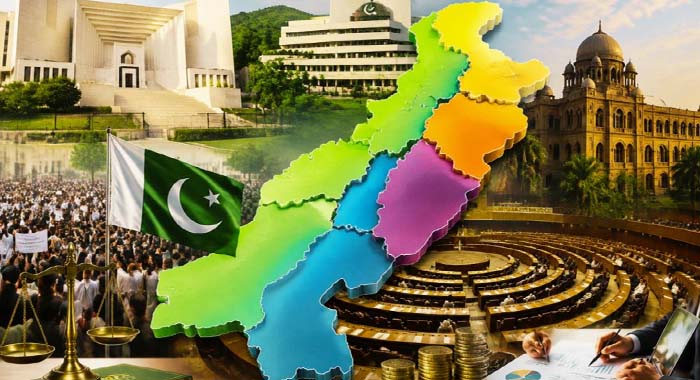
Let us now turn to the issue of new provinces and administrative units. The federal government had floated the idea of making Islamabad a separate province, but after serious questions were raised over the proposal, it appears to have stepped back. Federal Minister for Parliamentary Affairs Dr Tariq Fazal Chaudhary clarified yesterday that Islamabad would not be made a province, although a powerful local-government-style setup could be introduced to improve governance.
The government may also have to reconsider its position on the creation of new provinces, because this is neither a simple nor an easy undertaking. Readers may recall how difficult it was to even change the name of the then North-West Frontier Province at the time of the 18th Amendment. After more than a month of debate and deliberation, the change could only be achieved by adding “Khyber” to Pakhtunkhwa.
If changing the name of a province proved so difficult, altering its geographical boundaries is obviously far more complicated. The creation of new provinces on the basis of genuine administrative needs may be inevitable, but it requires thorough homework and broader political consensus. In this context, reference is often made to the resolutions previously passed by the Punjab and Khyber Pakhtunkhwa assemblies regarding South Punjab and Hazara provinces. However, some quarters consider those resolutions time-barred and obsolete.
In my view, while dialogue on the creation of new provinces should continue, equal attention needs to be given to improving governance within the existing provincial structure. Over the past several decades, weak political leadership and prolonged confrontation among politicians have seriously damaged the administrative structures of the provinces. Taking advantage of this situation, the bureaucracy has gradually taken the system hostage and expanded its influence to such an extent that successive governments appear to have little effective control over it.
This, however, is such a vast subject that it is difficult to cover it adequately here. It would therefore be more appropriate to discuss it separately.
Pakistan,s Politics: Long Marches, New Provinces and a Changing Regional Landscape