
By Riaz Hussain
Peshawar: Pakistan’s suspension of commercial trade through key crossings with Iran has intensified pressure on the country’s regional trade at a time when commerce with Afghanistan remains severely disrupted.
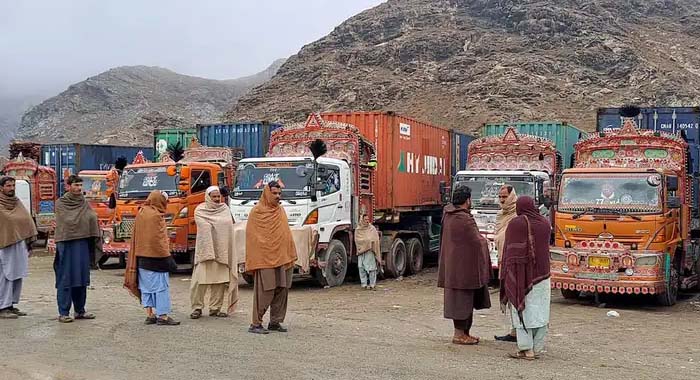
The latest restrictions have stranded hundreds of cargo containers and raised concerns about export earnings, employment, supply chains and the rising costs faced by businesses and consumers.
On October 17, 2026, Pakistan suspended commercial trade through the Gabd-Rimdan and Taftan crossings with Iran. The closure disrupted the movement of goods, including liquefied petroleum gas (LPG), rice and fresh fruit, according to reports by Pakistani and international media.
Pakistani officials cited security concerns, anti-smuggling measures and the need to improve border management, while Iranian officials reportedly referred to technical issues and precautionary measures. Both sides described the suspension as temporary.
Shahid Rind, spokesperson for the Balochistan government and adviser to the provincial chief minister, said the restrictions were intended to address security concerns, prevent smuggling and strengthen administrative controls along the border.
The latest disruption comes amid prolonged restrictions on Pakistan-Afghanistan trade, which have significantly reduced commercial activity between the two neighbours since October 2025.
According to State Bank of Pakistan bilateral trade with Afghanistan declined from $1.3 billion in fiscal year 2024–25 to $358 million in fiscal year 2025–26, a fall of more than 72 per cent.
Trade with China, by contrast, remains substantial but heavily tilted towards imports. Pakistan imported approximately $19.54 billion worth of goods from China during the same fiscal year, while exports to China stood at about $2.68 billion, according to the reported figures.
The figures illustrate the imbalance in Pakistan’s regional trade relationships: limited access to some neighbouring markets, declining commerce with Afghanistan and Iran, and substantial dependence on imports from China.
Economic costs extend beyond trade figures
Economists and analysts say prolonged restrictions on regional commerce can affect far more than national import and export totals. Border communities, transporters, customs agents, warehouse workers, farmers and small businesses are among those exposed to the consequences.
Fida Hussain, an economist, said Pakistan’s decision to restrict trade with Iran should be examined in the context of regional geopolitics and Islamabad’s strategic relationship with Saudi Arabia.
“Riyadh’s concerns over Iran’s regional role may have influenced Islamabad’s decision, although the extent of this influence remains uncertain,” he said.
Hussain warned that trade restrictions could carry significant economic costs when Pakistan was already struggling with inflation and high energy prices.
“Trade with Afghanistan supports Pakistani exports and foreign-exchange earnings, while Iranian liquefied petroleum gas (LPG) can offer a relatively cheaper alternative,” he said.
He argued that Pakistan needed to balance its security requirements with economic interests rather than allow restrictions to undermine commercial opportunities.
“Restricting commerce may put pressure on Iran, but it can also increase domestic costs, hurt businesses and add to the burden on ordinary Pakistanis,” Hussain said.
High production costs weaken export competitiveness
Journalist and economic analyst Tahir Ameen said Pakistan’s regional trade remained well below its potential, limiting opportunities to expand exports and create employment.
“Pakistan’s exports, worth around $30–32 billion, are concentrated in limited markets. High energy prices, interest rates and production costs make Pakistani products less competitive than those of regional competitors such as Bangladesh, Vietnam and India,” he said.
Ameen added that restrictions on land routes could force exporters to rely on more expensive shipping and alternative transport arrangements, increasing costs and reducing competitiveness.
He said Pakistan needed to diversify its export markets, reduce production costs and improve regional trade to strengthen foreign-exchange earnings.
“Pakistan needs to diversify export markets, reduce production costs and improve regional trade to boost exports, create jobs and strengthen the economy,” he said.
The trade imbalance with China presents another challenge. While Chinese imports provide Pakistani businesses and consumers with access to a wide range of products, comparatively low exports to China highlight the difficulty Pakistan faces in expanding its share of the Chinese market.
Increasing exports would require improvements in productivity, product quality, market access and the competitiveness of domestic industries.
Security and trade need not be mutually exclusive
Professor Dr Sajad Ahmad said restrictions on trade with Iran and the prolonged disruption of commerce with Afghanistan had caused significant difficulties for traders, businesses and communities in Balochistan and Khyber Pakhtunkhwa.
“Pakistan should separate trade from politics. Despite historical conflicts and political tensions, countries in the European Union, Southeast Asia and elsewhere continue trading because they recognise the economic benefits of regional cooperation,” he said.
Ahmad said border restrictions affected not only exporters and transporters but also ordinary people, including Afghan patients seeking medical treatment and students pursuing education in Pakistan.
He added that traders dealing in fruits, vegetables, cement and other goods faced difficulties when established commercial routes were disrupted.
At a time when Pakistan needs stronger foreign-exchange earnings and continues to rely on international financial assistance, Ahmad said expanding regional trade should be an economic priority.
“Instead of repeatedly closing borders, Pakistan should facilitate cross-border commerce, protect security and create opportunities for businesses and local communities,” he said.
Can Pakistan protect security without losing markets?
Pakistan’s regional trade challenges raise questions about how the country can protect its borders while maintaining legitimate commercial activity with neighbouring states.
The suspension of trade with Iran could affect the availability and cost of some goods, particularly if alternative suppliers cannot fully compensate for disrupted supplies. However, the extent of any impact on LPG prices, food costs and transport expenses will depend on the duration of the restrictions, existing stocks and the availability of alternative supply routes.
Similarly, the sharp decline in trade with Afghanistan has reduced commercial opportunities for exporters and traders who previously depended on cross-border markets. The effects are likely to vary across industries and border communities.
Analysts say Pakistan could explore monitored trade arrangements, stronger customs enforcement, improved cargo screening and coordinated security procedures to reduce the risks associated with cross-border commerce.
Such measures could help authorities address smuggling and security concerns while allowing legitimate shipments to move under regulated conditions.
The broader challenge is not simply the closure of individual trading routes. It is whether Pakistan can expand its export markets, reduce its dependence on imports, protect livelihoods in border regions and develop a more predictable regional trade policy.
For an economy seeking sustainable growth and stronger foreign-exchange earnings, balancing national security with the economic benefits of regional commerce remains an increasingly important policy test.