By Ibn-Taha and Syed Ahmer Raza
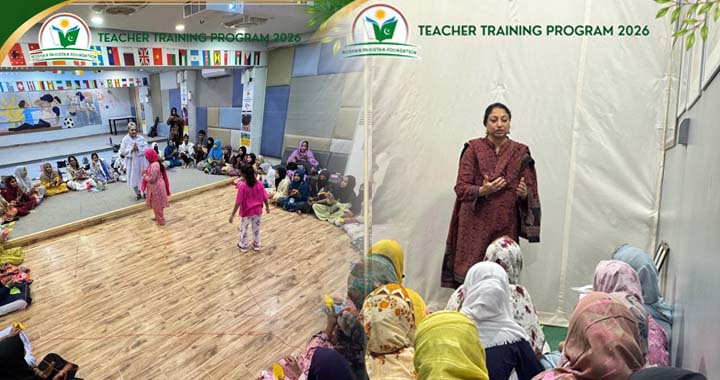
KARACHI- The students were jubilant, parents proud and teachers visibly moved as the Summer Teacher Training Program 2026 came to a close. For the organizers, however, the ceremony represented something larger than the completion of a professional course: a belief that lasting educational change begins with the people standing in front of the classroom.
The program, organized under the auspices of the Roshan Pakistan Foundation (RPF), brought together educationists, psychologists, doctors, communication specialists, technologists, media professionals and community leaders under the theme “Empowering Educators, Transforming Futures.”
Its premise was straightforward: Teachers cannot transform classrooms unless they themselves are given the tools, confidence and support to change.
Over the course of the program, educators were trained in cognitive and participatory learning, leadership, emotional intelligence, technology and artificial intelligence, child protection, civic responsibility, social development and emergency preparedness. The program was built around four principles — Inspire, Connect, Grow and Transform — and emphasized a philosophy that its organizers call “Connect Before Correcting.”
But the story behind the foundation is rooted in a much harsher reality.
A childhood shaped by poverty and social restrictions
For Humera Bachal, the founder of Roshan Pakistan, the decision to dedicate her life to education began with experiences she witnessed as a child.
She recalls seeing a young woman experiencing childbirth being sent to a buffalo barn for medical treatment, where injections were administered using syringes that had also been used on animals. For girls in the community, education was considered unnecessary, even dangerous. Marriage and domestic responsibilities were viewed as their predetermined future.
Bachal was born in 1988 in Thatta, Sindh, to Muhammad Bachal and Zainab Bibi. Her family, struggling under heavy debt, eventually moved to Karachi when she was 8.
Poverty was not an abstract concept for her. She remembers searching for leftover food and collecting firewood to help her family survive. She also remembers her mother’s hands bleeding as she cut wood.
Those experiences, she says, strengthened her determination to build a different future.
Her resolve deepened after the death of a cousin’s child who was mistakenly given an expired medicine. The tragedy convinced her that education had to mean more than teaching people to read and write. It had to give communities the knowledge to make informed decisions about health, safety and their future.
So she began teaching wherever she could — under streetlights, in rented rooms, on roadsides and in whatever spaces were available.
From a small school to a broader mission
Bachal eventually completed her FA in Humanities and later earned a bachelor’s degree in Liberal Arts and Sciences, with a focus on General Studies and Humanities, from Benazir Bhutto Shaheed University in Karachi.
After almost 15 years of struggle, a group of philanthropists helped her establish Dream Model School in Mochi Goth, Karachi.
The school was designed to go beyond conventional classroom education. Alongside academics, it incorporated physical and mental well-being, reproductive health and social empowerment.
In a community where menstruation was often treated as a taboo, the school introduced menstrual hygiene education and provided sanitary products to girls. It also established basic health services and mental-health counseling, including support for students dealing with anxiety, stress and trauma.
What began as a school gradually evolved into a wider humanitarian effort.
Today, that effort operates as the Roshan Pakistan Foundation, working in education, health care, food security, disaster relief, community welfare and economic empowerment.
The organization operates four formal school campuses, from nursery through Grade 10, as well as four informal education centers. It also runs adult literacy and digital literacy programs.
Its welfare activities include food-ration distributions, winter clothing drives and Ramadan food programs. Health initiatives include school-based clinics, medical camps and mental-health and well-being programs.
During disasters, the organization has provided temporary kitchens, emergency health services and shelter while working with partner organizations on longer-term rehabilitation.
Teaching teachers to see beyond the textbook
The foundation’s teacher-training program reflects that broader philosophy.
Teachers are taught that their role extends beyond delivering lessons. They are mentors, role models and community figures whose daily interactions can influence a child’s confidence, values and ambitions.
The program introduces educators to artificial intelligence and digital tools that can make learning more interactive and personalized. Storytelling and real-world experiences are used to connect classroom lessons with the problems students encounter outside school.
Participants also receive practical training in emergency response, including fire safety, burns, fractures, earthquake preparedness, choking, heatstroke, heart attacks, seizures and drowning emergencies.
Communication sessions focus on building classrooms in which students feel heard and respected. Other sessions explore personality differences and ways teachers can adapt their approaches to children with different emotional, behavioral and learning needs.
Child-safety training addresses safeguarding responsibilities and practical measures for creating secure school environments.
One session, titled “Calm Classrooms, Strong Minds,” takes teachers outdoors to focus on mindfulness, emotional well-being and stress management.
The idea is that a teacher’s ability to create a calm and supportive environment can be as important as the lesson itself.
A cause larger than recognition
Bachal’s work has attracted the support of educationists, philanthropists, doctors, volunteers, social reformers, communication experts and community leaders, including Dr. Adina Sheikh, Dr. Kishwar Enam, Sabina Khatri of the Kiran Foundation, and educationists Madiha Shaikh, Maham Zehra, Almas Baloch, Umme Haris, Ishaq Bin Sadiq and Danial Hussain Shaikh, as well as technology expert Areeb Minhaj.
The foundation’s guiding philosophy is summed up in a simple phrase:
“Together, we empower educators. Together, we transform futures.”
For Bachal, however, the ultimate measure of success is unlikely to be an award or an international honor.
A devoted admirer of the late humanitarian Abdul Sattar Edhi, she says her ambition is not the Nobel Prize or public recognition.
It is education.
And, through education, the possibility of changing lives.
Not for a Nobel Prize — but for a noble cause.