
Riaz Hussain :
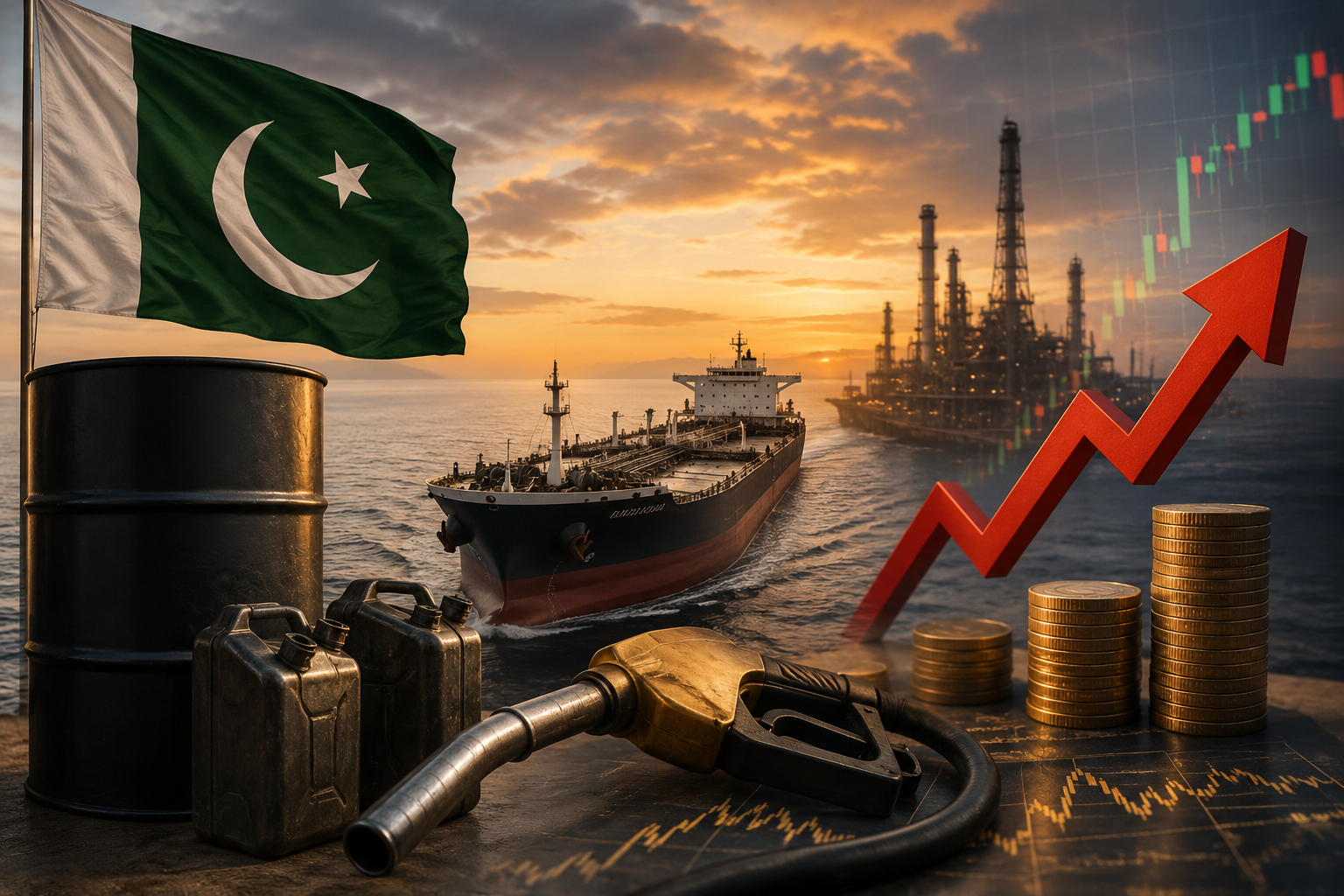
Rising international oil prices and higher domestic petroleum rates are threatening to add to Pakistan’s inflationary pressures, as uncertainty over the Middle East conflict and disruptions in shipping through the strategic Strait of Hormuz raise concerns about the country’s energy import bill.
Oil prices rose for a third consecutive session on Tuesday as prospects for a deal to end the Middle East conflict weakened. According to Reuters, Brent crude futures rose 89 cents, or about 1%, to $91.76 a barrel, while U.S. West Texas Intermediate (WTI) crude gained $1.05 to $85.55 a barrel.
The latest increase came after Iran signalled that it could adopt a “fully offensive” military posture as efforts toward a permanent ceasefire stalled. The United States has also ruled out extending a temporary ceasefire agreement, increasing fears that the conflict could continue and further disrupt energy supplies.
The Strait of Hormuz remains at the centre of the oil-market concerns. Shipping traffic through the strategic waterway, which is crucial for global energy supplies, has remained at only a fraction of normal levels. A projectile struck a vessel transiting out of the strait on Tuesday, according to tracking information cited by Reuters.
For Pakistan, prolonged disruption in the region could have significant economic consequences because the country remains heavily dependent on imported crude oil and petroleum products to meet domestic energy requirements.
Pakistan imports roughly 70% of its crude oil requirements, making international oil prices and shipping costs particularly important for domestic fuel prices, inflation and the country’s external account.
The impact is already being felt by Pakistani consumers.
The federal government on Monday increased the price of petrol by Rs5.77 per litre and High Speed Diesel (HSD) by Rs6.47 per litre, effective Tuesday, August 18.
According to the Petroleum Division notification, petrol increased from Rs325.43 to Rs331.20 per litre, while HSD rose from Rs383.95 to Rs390.42 per litre.
The latest fuel-price increase comes at a sensitive time for Pakistan’s economy, with inflation already considerably higher than a year earlier. Pakistan’s Consumer Price Index (CPI) inflation accelerated to 11.7% year-on-year in May 2026, its highest level in nearly two years, compared with 10.9% in April and 3.5% in May 2025.
Higher fuel prices can transmit quickly through the wider economy. Petrol affects household transport costs, while diesel is particularly important for freight, agriculture, construction and public transportation. Any sustained increase in diesel prices can therefore raise the cost of transporting food and other essential commodities from farms, ports and industrial centres to markets.
Economists also warn that higher international oil prices could widen Pakistan’s import bill and put additional pressure on foreign exchange reserves.
The country already faces a substantial trade deficit, and an increase in the value of petroleum imports could make it more difficult to contain external financing requirements. Higher oil prices could also increase pressure on the rupee if importers require more dollars to pay for energy supplies.
The impact could become more severe if the Middle East conflict results in a prolonged reduction in oil shipments through the Strait of Hormuz.
Tim Waterer, chief market analyst at KCM, told Reuters that a deal to reopen the Strait of Hormuz did not appear to be in sight and that shipping activity remained at only a trickle.
DBS Bank’s head of energy research, Suvro Sarkar, said uncertainty surrounding a potential agreement could affect oil-price expectations into the fourth quarter and even 2027. He expected oil prices to remain in an $80-$100-a-barrel range in the near term while the uncertainty continued.
For Pakistan, even a temporary period of prices near the upper end of that range could create significant fiscal and economic challenges.
Higher oil prices would increase the cost of imported energy, potentially push up petroleum-product prices and add to inflation. They could also increase government expenditure on fuel-related subsidies or other relief measures if authorities attempt to protect consumers from the full impact of international price increases.
The effects would not be limited to petrol stations. Higher fuel costs can increase electricity-generation costs where imported fuels are used, raise transportation charges and eventually feed into the prices of food, manufactured goods and services.
The developments therefore present a difficult policy challenge for Islamabad: protecting consumers from another inflationary shock while maintaining fiscal discipline and meeting external financing obligations.
With Pakistan importing a large share of its crude oil and petroleum requirements, a prolonged surge in global oil prices could quickly translate into higher domestic energy costs.
Analysts say the key risk for Pakistan is not simply the current rise in crude prices, but whether the Middle East conflict continues to restrict energy shipments through the Strait of Hormuz. If disruptions persist, the combination of higher oil prices, increased import costs and rising domestic fuel prices could put renewed pressure on inflation and Pakistan’s already fragile external position.