

Muhammad Younas | Peshawar, Pakistan :
Khyber Pakhtunkhwa has introduced Pakistan’s first provincial disaster risk reduction policy, a year after floods killed hundreds in the country widely ranked as the world’s most climate vulnerable nation.
The day after flash floods tore through Buner district in northern Pakistan last August, a Reuters photographer came upon a man named Nisar standing amid the ruins of his house in the village of Bayshonai Kalay. He was 45 years old. There is no record of anything he said. Only the photograph remains, one of thousands taken that week across a stretch of the Khyber Pakhtunkhwa hills where cloudbursts had sent walls of water down narrow valleys faster than anyone could run.
By the time the region’s rescue service finished its search, the scale of the damage was difficult to comprehend. Bilal Ahmed Faizi, a spokesman for Khyber Pakhtunkhwa’s Rescue 1122 service, told reporters that his teams still believed dozens of people were buried under debris, and that the odds of finding anyone alive were slim. Months later, when Pakistan’s National Disaster Management Authority filed its final accounting with the Peshawar High Court, the toll for the province’s 2025 monsoon season stood at 504 dead, 256 of them in Buner district alone. More than three thousand homes had been damaged. Nearly five and a half thousand livestock, often a family’s only real asset, had been swept away.

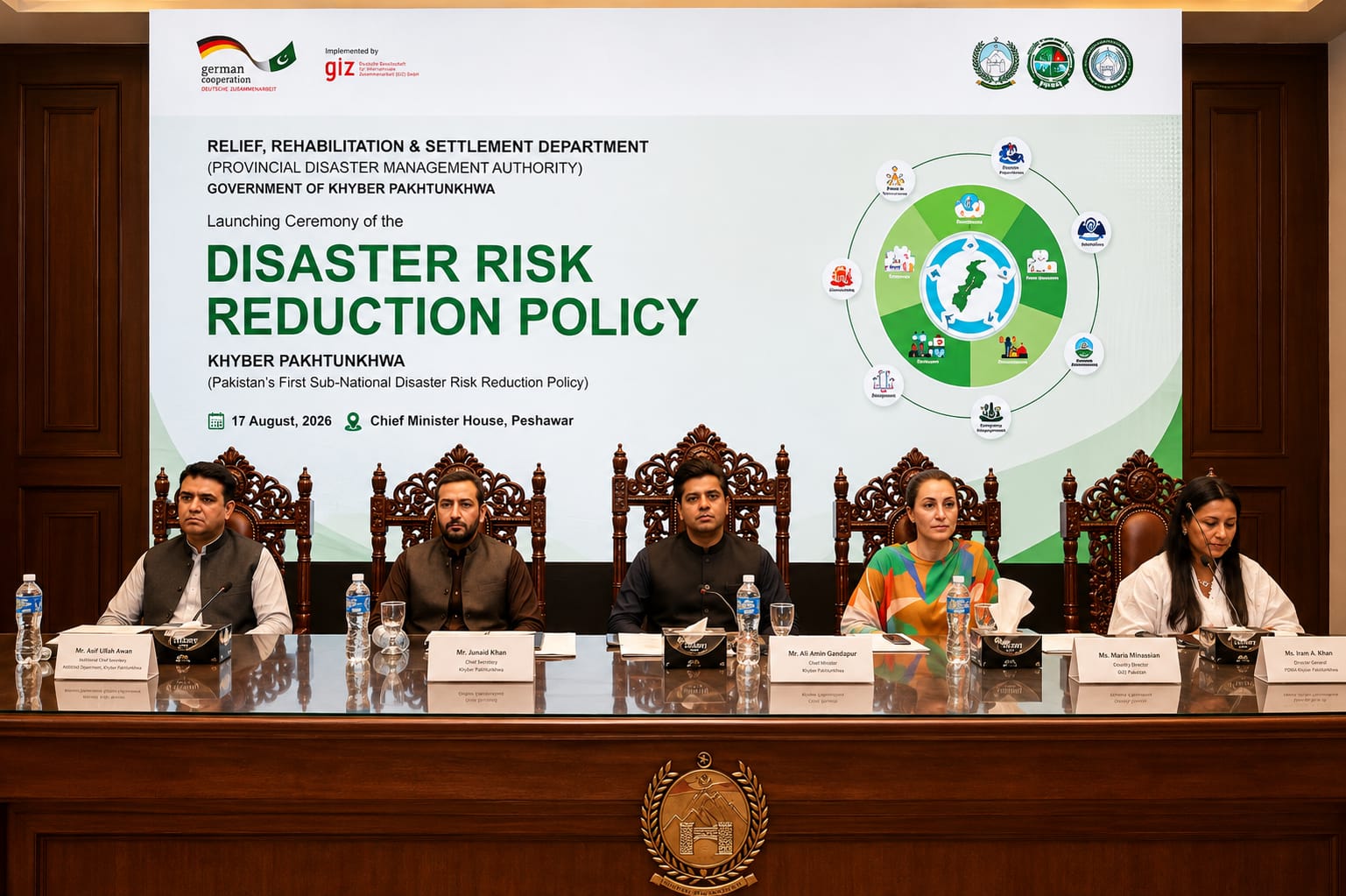
It is against that backdrop that officials in Khyber Pakhtunkhwa gathered in Peshawar on August 17, almost exactly a year after the floods, to unveil what they are calling Pakistan’s first provincial Disaster Risk Reduction Policy: a five year framework meant to shift the government’s attention from the aftermath of disasters toward the years of preparation that come before one.
The policy arrives at a moment when Pakistan’s vulnerability to extreme weather has drawn increasing international attention. Germanwatch, a European research organization that has tracked the human and economic toll of climate related disasters worldwide since the mid 2000s, ranked Pakistan as the single most climate vulnerable country in the world for the year 2022, the year catastrophic floods submerged a third of the country, killed more than 1,700 people and caused an estimated 30 billion dollars in damage. The organization noted that Pakistan produces less than one percent of the world’s greenhouse gas emissions, a statistic frequently cited by Pakistani officials in international climate negotiations as evidence that the countries suffering the most from a warming planet are rarely the ones most responsible for it.
A shift from response to prevention
The new policy was drafted by Khyber Pakhtunkhwa’s Provincial Disaster Management Authority, working alongside the Relief, Rehabilitation and Settlement Department, with financial and technical assistance from the German government and its development agency, GIZ Pakistan.
Speaking on behalf of the Chief Minister, the provincial Minister for Information and Public Relations, Shafi Ullah Jan, described the policy as something closer to a promise than a plan. “This is not merely a document, but our government’s solemn commitment to safeguarding the lives and properties of our forty million citizens,” he told the gathering, adding that the province needed to move away from what he called a culture of relief and toward one built on anticipating danger before it arrived.
Arifullah Awan, the authority’s director general, offered a more granular explanation of what that shift is meant to look like in practice. For years, he said, nearly all of the province’s energy and resources have gone into what happens after a flood, through search, rescue and emergency relief. The new policy instead puts weight behind the less visible work that comes earlier: tighter coordination between government departments that have not always communicated well, stronger early warning systems, sustained public awareness campaigns, and development choices, about where roads, schools and homes are built, that take flood and landslide risk into account from the outset rather than as an afterthought.
Germany’s stake, and a debate over root causes
Germany’s involvement in the policy reflects a broader relationship between Berlin and Islamabad on climate adaptation. Speaking on behalf of German Ambassador Ina Lepel, Dr. Mirjam Büdenbender-Buchholz, the German Embassy’s head of cooperation, congratulated the province on what she called Pakistan’s first policy of its kind and reaffirmed her government’s continued support. She argued that the risks facing Khyber Pakhtunkhwa have accumulated over many years, driven by a combination of heavier rainfall, population growth, informal settlements spreading onto flood prone land, weak enforcement of land use regulations and the loss of forest cover on hillsides that once slowed floodwater before it reached villages below.
That assessment broadly matches what independent researchers concluded after studying last year’s floods in Buner and Swat, who pointed in particular to unregulated mining along riverbeds, which had loosened the surrounding terrain, and to construction that had steadily crept into floodplains that were never safe to build on.
Johanna Knoess, who leads GIZ Pakistan’s Adaptive Social Protection programme, framed the challenge somewhat differently, arguing that understanding who is truly at risk requires looking at two overlapping questions rather than one. It is not enough, she said, to know who is poor, and it is not enough to know who lives near a river. What tends to determine who is left with nothing after a flood is where those two circumstances intersect. In Swat’s low lying neighborhoods after last year’s disaster, aid workers reported meeting women whose husbands worked as day laborers or ran small shops, families renting rooms close to the water because that was what they could afford, left to clear the mud from homes that were never truly theirs.
A cost governments elsewhere have learned to plan for
Climate researchers who study disaster preparedness across South Asia often point to Bangladesh as an example of what earlier investment in warning systems and evacuation planning can achieve. Despite facing comparable exposure to cyclones and flooding, Bangladesh has, over recent decades, significantly reduced its storm related death toll through community based early warning networks and shelter systems built well before a storm arrives, a comparison Pakistani climate researchers have increasingly raised in discussing what their own country’s disaster policy might learn from.
Khyber Pakhtunkhwa’s Chief Secretary made a related argument in more institutional terms, telling the gathering that disaster management could no longer be treated as a secondary function of government but should instead be understood as a matter of basic governance and fiscal responsibility, since every flood the province fails to prepare for becomes a cost it eventually pays regardless.
The Secretary of the Relief, Rehabilitation and Settlement Department, Sohail Khan, was more cautious. He described the launch as the beginning of the difficult part of the process rather than its conclusion, and said the policy would only matter if departments with a long history of working in isolation began genuinely coordinating with one another. Several other officials returned to that same concern over the course of the ceremony, in different words but with a shared undertone of caution.
A familiar pattern, and an uncertain test ahead
None of this is unfolding in isolation. In 2023, storms killed at least 27 people across Lakki Marwat, Karak and Bannu districts. In 2022, the floods that reshaped Pakistan’s standing in global climate rankings displaced millions nationwide. Each disaster has prompted broadly similar explanations from officials and outside researchers alike: a warming climate producing heavier and less predictable rainfall, forests thinned or cleared from hillsides that once absorbed floodwater, and construction that continues to expand into places long known to flood.
The policy introduced this week is organized around five pillars: early warning systems, risk informed development planning, community resilience, disaster risk financing, and social protection for the households most likely to bear the brunt of the next flood or storm. Whether it changes outcomes the next time a cloudburst strikes the mountains above Swat will depend on funding that has not yet been allocated, on departments with a long record of working separately rather than together, and on whether the commitments made in Peshawar this week are still being honored when the next monsoon arrives.
The ceremony closed with Mr. Jan presented shields to the officials, technical experts and partner organization representatives who had worked on the policy, alongside renewed pledges to see it through. Officials have not yet released a detailed budget, an implementation timeline, or a district by district plan describing how the policy will actually be carried out. Those specifics, still unannounced, are likely to matter more than anything said at the launch when the next rainy season tests whether Khyber Pakhtunkhwa has genuinely changed how it prepares, or simply changed how it talks about being prepared.