

Riyaz Hussain
ISLAMABAD — Pakistan could suffer an estimated $4.5 billion loss in exports because of the prolonged closure of its border and trade routes with Afghanistan, according to a new report by the Pakistan Institute of Development Economics (PIDE).
The report comes as trade between the two countries has faced serious disruptions since October last year following the closure of key border crossings.
In October 2025, sporadic clashes broke out along the Pakistan-Afghanistan border. Although the two sides later agreed to a ceasefire following talks in Doha, border and trade-related problems remain unresolved.
The Customs Clearing Agents Association at the Torkham crossing says thousands of people have lost their jobs and numerous businesses have been affected by the suspension of trade.
Mujib Rahman, head of the association, said about 4,200 laborers, customs workers and their families had been affected at the Torkham terminal alone.
He urged Pakistan and Afghanistan to resolve their disputes through dialogue and keep trade separate from political and security disagreements.
Trade volume declines
According to the PIDE report, bilateral trade between Pakistan and Afghanistan fell by 28 percent in 2025, declining from $2.46 billion in 2024 to $1.77 billion in 2025.
The report estimates that Pakistan’s exports have declined by an average of about $177 million per month since the border closures, representing a 56 percent drop in export levels by the beginning of 2026.
PIDE, however, noted that the methodology used to calculate the monthly loss of $177 million was not clearly explained in the source material. The figure should therefore be viewed as an estimate of potential losses rather than an independently verified amount.
The report also said the prolonged closure had increased transportation costs. Container rentals, fuel costs for refrigerated trucks, delays and detention fees have reached between $150 and $200 per container per day.
Search for alternative trade routes
Khan Jan Alokozai, a former head of the Pakistan-Afghanistan Joint Chamber of Commerce, said the two countries were currently exploring alternative trade routes and that the Torkham crossing and other traditional routes might not reopen soon.
Alokozai said the existing trade route between Pakistan and Afghanistan was the shortest and least expensive option for both countries. Its closure, he added, was causing economic losses on both sides.
Factories in Khyber Pakhtunkhwa and Punjab affected
Shahid Hussain, a former president of the Sarhad Chamber of Commerce and Industry in Khyber Pakhtunkhwa, said numerous large and small factories in Khyber Pakhtunkhwa and Punjab had been affected by declining trade with Afghanistan and Central Asia.
He said medicines, construction materials, clothing, cement, steel and other products manufactured in the two provinces had previously been exported to Afghanistan and Central Asia. However, exports of these goods have declined or stopped because of the closure of trade routes.
Thousands of containers stranded
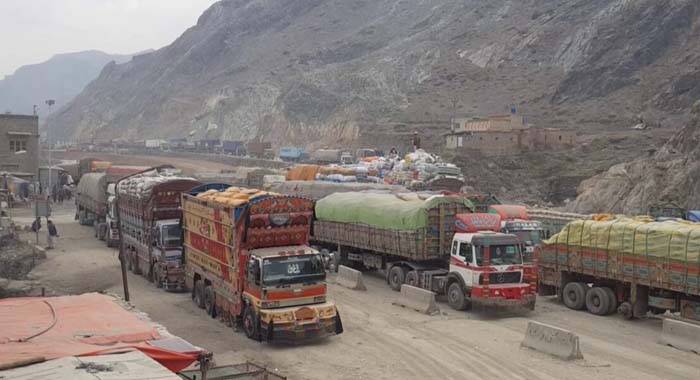
The Pakistan-Afghanistan Joint Chamber of Commerce (PAJCC) estimates that between 10,000 and 12,000 containers were stranded around Torkham and other major border crossings in January and February 2026, causing monthly losses of about 50 billion Pakistani rupees.
The Central Asia Regional Economic Cooperation (CAREC) Corridor Performance Measurement and Monitoring Framework also identifies Torkham and Chaman as among the region’s border crossings where cargo clearance takes the longest.
According to the report, complex anti-smuggling inspections, weak infrastructure and administrative hurdles raise transportation costs even during normal periods. These costs increase further during security crises and clashes.
PIDE said the figures used in the report were compiled from government sources, trade associations and media reports. They should therefore be treated as estimates rather than independent and verified measurements of the losses.
The institute said the Pakistan-Afghanistan trade corridor was particularly important for fruits, vegetables and other perishable goods. Prolonged border closures have led to spoilage, reduced traders’ incomes and price instability in markets.
The report added that the impact of repeated border closures extended beyond bilateral trade, potentially affecting production, commercial ties, the supply and demand of goods, and food security over the long term.