

By Eman Ali :
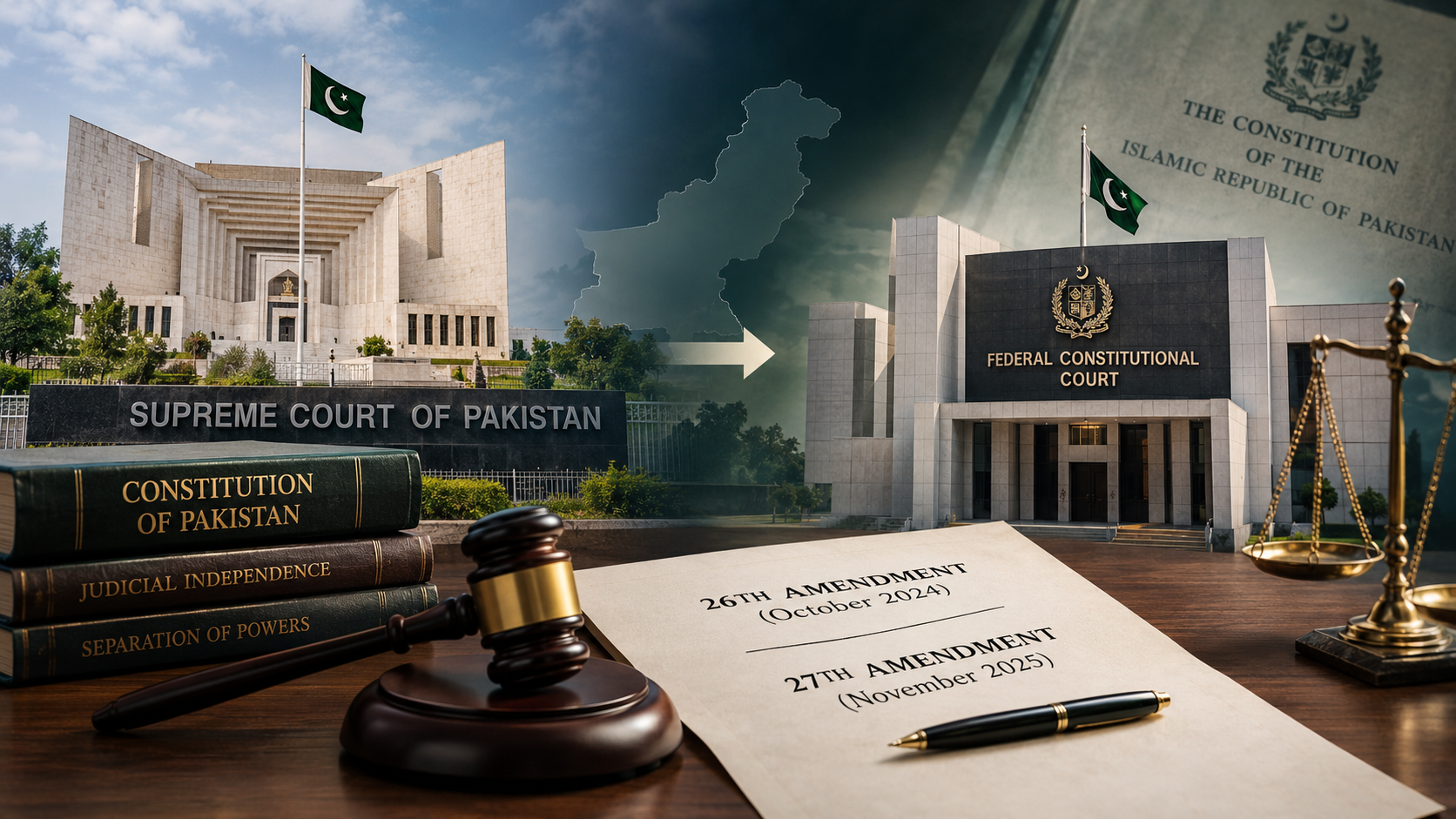
In the span of just thirteen months, Pakistan’s constitutional architecture has undergone its most consequential restructuring since the Eighteenth Amendment. The Twenty Sixth Amendment of October 2024 altered how judges are appointed and who becomes Chief Justice. The Twenty Seventh Amendment, signed into law in November 2025, went further still: it created an entirely new apex forum, the Federal Constitutional Court (FCC), and stripped the Supreme Court of Pakistan of jurisdiction it had exercised since 1973. Ten months on, with the FCC having just opened its second judicial year, it is possible to assess what this reorganization means for the doctrine of judicial independence and the separation of powers in Pakistan.
This article traces the two amendments, examines the institutional design of the FCC, surveys the jurisprudential and professional response, and situates Pakistan’s experience within the broader comparative debate on specialized constitutional courts and executive influence over the judiciary. Prior to October 2024, the senior most judge of the Supreme Court was elevated to Chief Justice as a matter of settled convention, and the Judicial Commission that nominated judges to the superior courts was dominated by sitting judges. The Twenty Sixth Amendment, passed by the National Assembly in an overnight session on 21 October 2024, changed both features. It created a Special Parliamentary Committee of eight National Assembly members and four Senators to select the Chief Justice of Pakistan from among the three most senior judges, rather than by seniority alone. It also reconstituted the Judicial Commission so that a majority of its members are no longer drawn from the judiciary itself.
Supporters characterized the reform as an assertion of parliamentary supremacy and a long overdue check on an unaccountable judiciary. Critics, including sitting judges, the Pakistan Bar Council, and international observers, argued that it subordinated judicial appointments to the ruling coalition’s political calculus, undermining the independence the appointments process was designed to protect. Notably, even after the amendment, the Supreme Court demonstrated a degree of continued assertiveness for instance in its ruling on reserved seats in Sunni Ittehad Council v. Election Commission of Pakistan (2024), which went against the interests of the ruling coalition. That episode of resistance forms part of the backdrop against which the Twenty Seventh Amendment should be read.
Where the Twenty Sixth Amendment adjusted personnel, the Twenty-Seventh Amendment restructured jurisdiction itself. Passed with unusual speed and minimal public deliberation in November 2025, it inserted Article 175A adjacent provisions and a new Article 175E into the Constitution, establishing the Federal Constitutional Court as a freestanding forum. The FCC formally came into being on 13 November 2025, and Justice Aminuddin Khan was appointed its inaugural Chief Justice the following day, selected by the President on the advice of the Prime Minister from among sitting Supreme Court judges.
The jurisdictional transfer is the amendment’s most significant feature. The FCC now holds exclusive original jurisdiction over three categories of dispute that the Supreme Court had held since the Constitution’s adoption: the interpretation of the Constitution, disputes between the federation and the provinces, and the enforcement of fundamental rights under Article 184(3). Any pending case falling within these categories was automatically transferred to the new court. The Supreme Court, meanwhile, retains only appellate jurisdiction in matters that do not involve constitutional interpretation a role some commentators describe as reducing it, in substance, to a court of ordinary appeal.
Beyond the court itself, the amendment also revised provisions governing the armed forces’ senior leadership and extended certain immunities to the President and military command, changes that critics argue were bundled into the same instrument to insulate them from judicial review by the very forum whose composition the executive now substantially controls.
The amendment’s passage produced an immediate and visible backlash within the legal community. Two sitting Supreme Court justices, Syed Mansoor Ali Shah and Athar Minallah, along with a Lahore High Court judge, resigned in protest, describing the amendment as an assault on the Constitution. The Lahore High Court Bar Association and lawyers in several cities announced strikes, and multiple petitions were filed before the Lahore High Court naming the Prime Minister and the Speaker of the National Assembly as respondents, arguing that the amendment strips the Supreme Court of its original jurisdiction and disturbs the judiciary’s constitutional architecture.
The practical question of how the FCC and the Supreme Court would coexist was not resolved by the constitutional text alone. Early friction emerged over overlapping subject matter for instance, a bench of the FCC held in a sales tax dispute that the Supreme Court could no longer engage in constitutional interpretation of legislation, a position that threatened to leave ordinary appellate work paralysed by jurisdictional uncertainty. This was eventually addressed by the Supreme Court itself: in a detailed judgment authored by a bench headed by Chief Justice Yahya Afridi, the Court held that the FCC and the Supreme Court function as parallel, non-subordinate courts, with the FCC’s rulings on questions of law binding on other courts, while ordinary civil and criminal appeals continue to run through the Supreme Court. That clarification has reduced though not eliminated the operational confusion, and the FCC used the occasion of its first judicial-year anniversary in September 2026 to reaffirm its commitment to institutional independence and to note that it has since established registries in all four provinces.
Specialised constitutional courts are not, in themselves, a departure from sound constitutional design; jurisdictions including Germany, South Africa, and South Korea operate dedicated constitutional benches or courts, often on the reasoning that concentrated expertise produces more coherent constitutional jurisprudence than a generalist apex court handling ordinary appeals alongside constitutional questions. Proponents of Pakistan’s reform have invoked this comparative logic, arguing that a dedicated forum will resolve constitutional questions more consistently and more quickly than a Supreme Court weighed down by an enormous appellate backlog.
The difficulty, as several constitutional scholars and international legal observers have pointed out, lies not in specialisation as such but in the sequencing and context of the reform. The FCC’s founding judges were appointed by the President on the Prime Minister’s advice rather than through an independent judicial process, at precisely the moment the Twenty Sixth Amendment had already given the executive a controlling voice over the ordinary Judicial Commission. Taken together, the two amendments transferred the most politically sensitive jurisdiction constitutional interpretation, fundamental rights enforcement, and federal provincial disputes away from a court that had shown occasional independence, and vested it in a newly created bench appointed through a process the executive substantially controls. Commentary from the International Commission of Jurists and constitutional law scholars has accordingly characterised the reform less as neutral judicial specialisation and more as a recentralisation of constitutional authority under executive influence, at a moment when historically consequential rulings from the Panama Papers case to disputes over electoral seat allocation illustrate exactly what is now at stake in who controls that jurisdiction.
There is, admittedly, a countervailing institutional fact worth weighing seriously: the Supreme Court’s own clarificatory ruling establishing that the FCC and Supreme Court are co-equal, non-subordinate courts suggests that the judiciary even in its diminished form retains some capacity for institutional self-assertion. Whether that capacity proves durable will depend heavily on how the FCC’s bench evolves as judges retire and are replaced, and whether the political consensus that produced the Twenty Seventh Amendment persists.
Pakistan’s experience over the past two years offers a live case study in how constitutional design choices the composition of appointing bodies, the sequencing of reforms, and the allocation of jurisdiction can reshape the practical meaning of judicial independence without ever formally abolishing it. The Federal Constitutional Court has not eliminated judicial review in Pakistan, and its early jurisprudence, including the parallel courts clarification, suggests an institution still finding its footing rather than a rubber stamp. But the manner of its creation swift, largely undebated, and interlocked with an appointments process already reshaped in the executive’s favor means that its long term legitimacy will be judged less by its founding instrument than by the independence it demonstrates, case by case, in matters the executive would prefer to lose. For law students and practitioners alike, the FCC’s next few years of docket will be the real test of whether Pakistan has gained a specialized guardian of the Constitution or lost, in substance, the independent apex court the 1973 Constitution was designed to secure